
Charles Hoskinson says Cardano is no longer the first elected treasurer explains why
Cardano Treasury votes to reject 12.29 million of the ADA allocation, with Input Output saying it no longer promises priority for Cardano
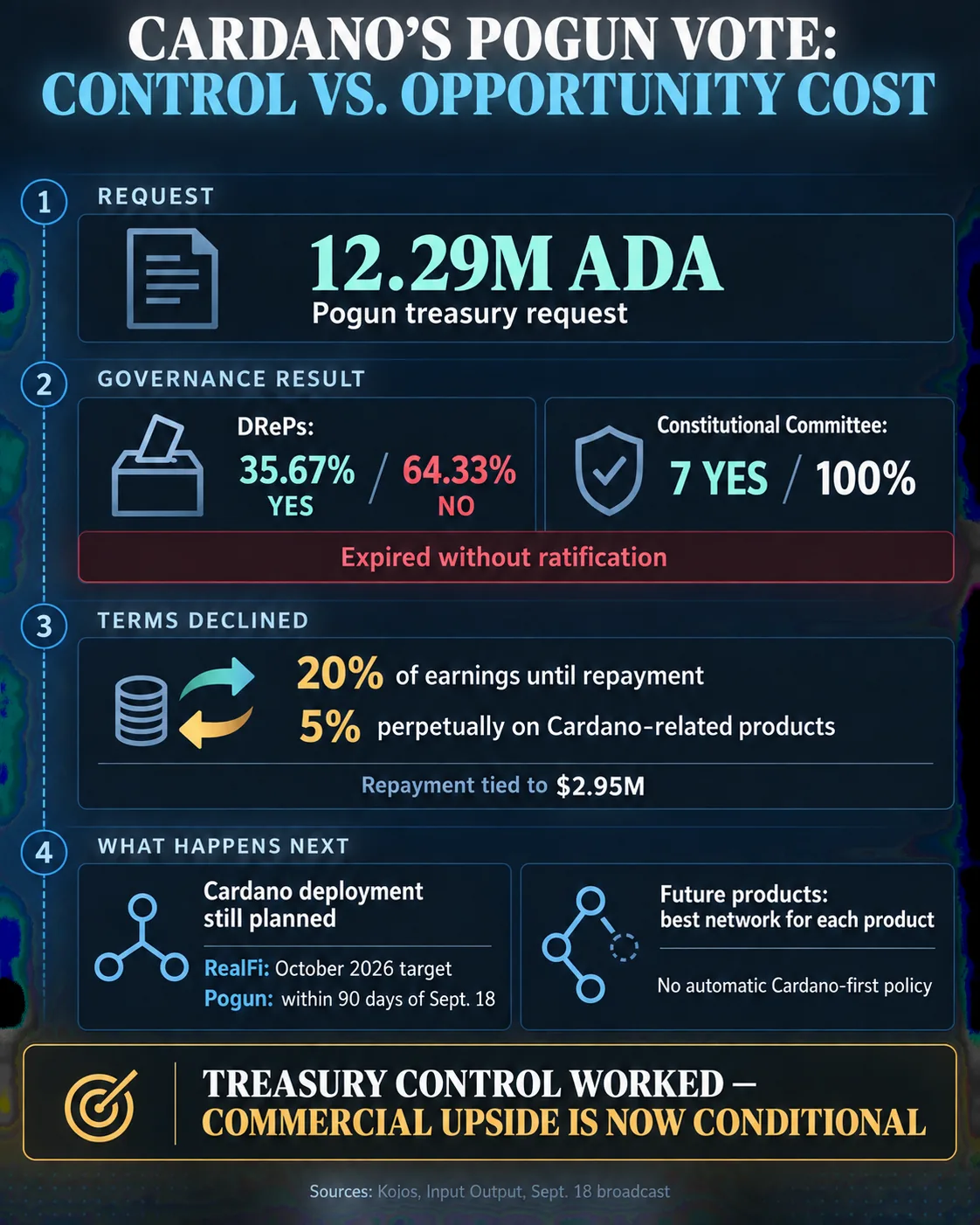
Cardano delegated governance voters did not approve Pogun's 1229000 ADA Treasury funding request, leaving the proposal to expire after a vote deadline. This result clearly shows that even though Input Output has deep historical roots as a founding development team and cannot automatically get support from network treasuries, Cardano 's decentralized governance mechanism is really working.
One vote, two conclusions
Pogun Governance Action petitioned Treasury Cardano for 122.9 million ADA and eventually expired without approval. Koios polling statistics show that 35.67% of delegated representatives (DRep) voted in favor, 64.33% against.
DRep voted with the ADA holders' voting rights, which directly determines whether this money can be withdrawn. By contrast, the Constitutional Committee review ended with seven votes in favor and 100% approval.
The two conclusions are not contradictory: the committee level expressed approval, but the actual allocation had to go through a vote by DRep, which failed to approve. Input Output was one of Cardano 's builders and remains an important participant in the network today, but its independent bodies remain firmly entrenched with ultimate decision-making power over where funding goes.
Rejected profit-sharing plans
The proposal also leaves voters with a business judgment issue. Input Output said in its April 2026 overview that Pogun would return 20% of the proceeds to Treasury Cardano until initial funds are recovered, after which it will provide a permanent 5% dividend on related products for Cardano .
The formal proposal defines this arrangement as a certain percentage of profits before amortization for quarterly interest and depreciation, with the repayment amount pegged at $2.95 million. Cardano This may be funded to support product development and recover expenses and share subsequent revenues along the path set out in the proposal.
DRep's are unwilling to risk the Treasury on a project with uncertain revenue and adoption prospects, while also forgoing its clear potential returns. Since Pogun has not yet generated any future earnings, usage or network distribution data that can be used to value this set of transactions, any claim as to how many tons Cardano was lost is speculative at this time.
Official end of the Cardano preferential rubber policy
Hoskinson stated in live streaming dated September 18, 2026, that Input Output will henceforth select the most appropriate network for each product, and no longer pursue a policy of always prioritizing Cardano frames.
At the same time, he emphasized that Cardano is still technically the best option for working with connectivity-class Bitcoin transaction output systems; RealFi is scheduled to go live on Cardano , in October 2026, while Pogon will be launched within 90 days after live streaming - roughly by mid-December. These dates are still forward looking targets.
Hoskinson said that if deployed as planned, Pogun could bring transaction fees to Cardano , TVL and trading volume . This would be a different economic relationship from the vetoed proposal: The network can benefit from on-chain activity without receiving dividends previously denied.
It is worth noting that the idea of Input Output decision-making by product predates this vote. Midnight City V2, a proxy application associated with the Midnight ecosystem, has been documented to be deployed on top of Midnight's network as early as July 2026.
Exclusive claims gap with on-chain records
The vote will also change Pogun's business incentives. Hoskinson said the unfunded product would not be exclusive to Cardano , and that traffic could potentially be redirected to other networks, with other ecosystems offering support in exchange for exclusionary status.
However, this exclusionary claim needs to be viewed with caution. The text of the on-chain proposal that has been reviewed contains a request for funding, repayment structure, permanent division and deployment intentions but does not contain explicit exclusive clauses. What can be confirmed from the record is: Cardano refused revenue participation; while Hoskinson's description describes follow-up actions that Input Output may take, there are no contractual counterparts in the proposal.
The collision of two independencies
The success of Cardano 's governance has limited the founding company's influence on community funding, and its responsibilities with DRep departments have failed to advance funds.
Network agencies have the right to spend from Treasury, while Input Output has a commercial option: it can finance elsewhere, negotiate with competing networks and incentivize partners willing to provide funds or distribution channels.
Pogun will examine how these two independencies interact. If deployed locally, costs and liquidity may flow to Cardano , while activity is also dispersed across other chains. If Cardano remains the primary location of Pogun, rejected revenue agreements might be worth more than exclusionary warnings; if activities are relocated elsewhere, network budget discipline would pay greater opportunity cost.
Either way, the outcome is consistent with decentralized 's original intention of governance: to protect its treasury from erosion by speculative investments but also means that Cardano will have to compete on its own merits for future Input Output products.
Warning signsThis article is for informational purposes only and does not constitute any investment advice. crypto asset Prices fluctuate wildly, please do your own research and assess the risks involved in this activity.
评论