
Why Russia's strict 1% cryptocurrency cap is actually protecting the assets of bank customers
Summary of events
On September 18, the Central Bank of Russia published a draft regulation proposing an upper limit on the risk-related capital ratio for crypto asset in the banking system, covering no more than 1% of the bank's own capital. The document aims to clearly delineate risk boundaries for banks engaged in business related to digital asset . It is still at the consultation stage and has not yet officially entered into force.
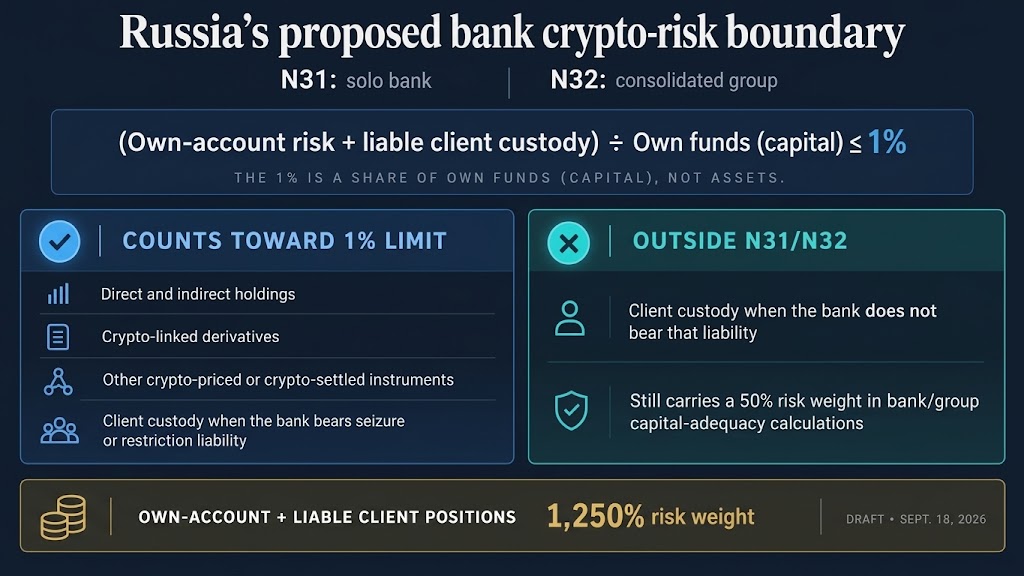
The proposal envisages the creation of two indices: N31 for individual credit institutions, and N32 to measure banking groups from a parallel perspective. Both ratios are compared with the corresponding tiered capital in terms of leverage coverage, based on capital rather than total assets. It should be noted that some client custodial positions do not count into this new formula.
Dual-layer structure and calculation methods
The draft adopts a two-tiered design, with the bank itself and its group facing an upper limit of the same proportion. N31 is based on own funds held by individual institutions, while N32 is based upon consolidated capital in the group, ensuring that measurements are always linked to the operating entities that actually bear the risk.
The following items are included: direct and indirect investments, derivatives pegged to the price of crypto asset , as well as instruments such as loans, bonds, guarantees, repurchase agreements and authorization limits that settle or value depend on crypto asset with foreign digital instruments.
Hedging operations have limited recognition. The hedge between long and short positions is restricted to the low-risk class defined in the draft, which has additional conditions on asset characteristics, settlement method, expiration date, freeze risk and liquidity risk. Direct holdings and other high-risk portfolios cannot be fully hedged by a more prudent approach than reverse positioning.
Differentiated treatment of client custodial assets
Whether or not client assets are included in the ratio depends on who is liable for losses if they are frozen or restricted to trading. A custodian position will be counted as N31 or N32 only when a bank itself, or a digital trustee within its group, has liability for damages; if the bank does not have this responsibility, then customer positions are excluded from both of these 1% caps.
However, the exclusion does not mean an exemption from prudential supervision. The draft assigns a 50% risk weight to client custody positions for which banks are not liable when calculating capital adequacy of covered banks and groups; up to 1250% risk weights apply to self-service portfolios as well as clients that require bank liability.
The implication of this differential design is that the custodian business does not need to treat all client assets as a bank's own portfolios, so long as institutions do not assume specific frozen or restricted liabilities; at the same time, banks' direct holdings and other crypto-related risks are still subject to strict capital constraints.
Follow-up schedule
The above ratios are part of the broader system of crypto market rules in Russia, where the regulatory framework is still being refined. According to the central bank's plan, the document is expected to be officially published in Q4 2026, with an effective date 10 days after publication. It is expected that banks will start reporting on instruments trading volume and N31/N32 values from January 2027, although specific reporting formats remain under development.
(This article was originally published by CryptoSlate)
评论