
Bitcoin breaks $80,000 milestone, but lacks firm support from institutional investors
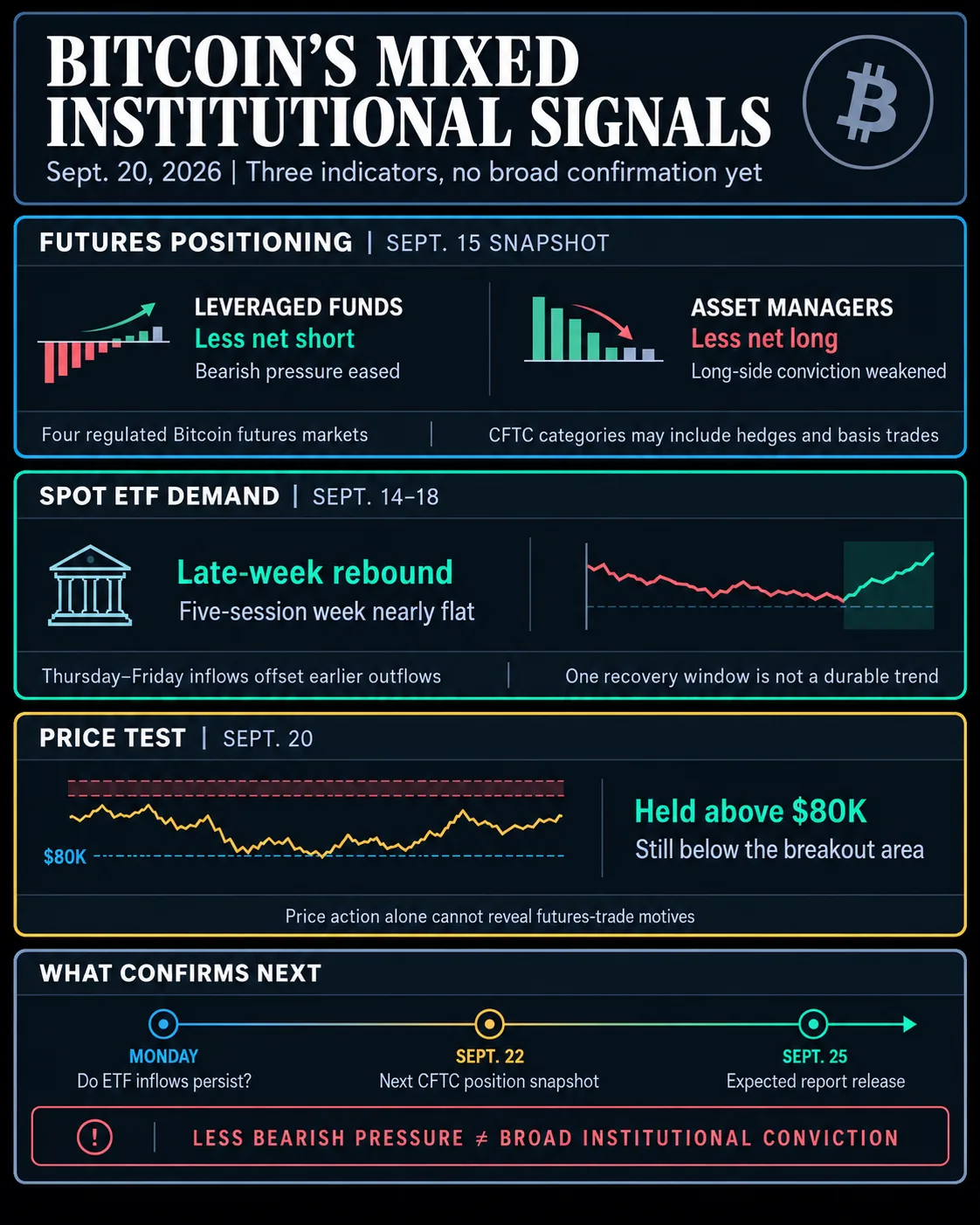
Bitcoin held steady at the $80,000 threshold over the weekend, but there was inconsistency in the direction of releases from all three types of institutional indicators. Leveraged funds saw a significant contraction in net outflows to regulatory futures markets while asset managers' net gains were decreasing simultaneously and Bitcoin ETF remained almost flat for the rest of the week. Why are these figures important?
Futures holdings: overnight repayments and multiple write-downs
The US Commodity Futures Trading Commission's (CFTC) September 15 holding snapshot shows a convergence of the leverage fund's net-zero opening in four regulated Bitcoin futures products, with total net zero decreasing by 7,275 positions equivalent to Bitcoin , compared to the previous week. At the same time, the combined net multiples of asset managers were reduced by about 4,733 units equivalent to Bitcoin .
This data covers only futures, including the Chicago Mercantile Exchange (CME) standard and micro Bitcoin futures contract , as well as Coinbase Derivatives nano and nano perpetual futures . Due to the different number of Bitcoin , represented by each contract, uniform conversion is required for statistical purposes.
After conversion, the leveraged fund's total net short position on September 15 was approximately 32,602 units of Bitcoin equivalents, down from about 39,877 units as at September 8. This narrowing is due to two changes: an increase in multi-headed portfolios and a decrease in hollow headers.
It should be noted that the CFTC's classification is based on the nature of a trader's primary business, rather than the specific purpose for holding each position. A position may be speculative, hedging, risk management or cross-market crypto arbitrage . As such, leveraged fund and asset manager portfolios are only reporting categories and do not represent consistent investment strategies.
ETF funds: The weekend warming up is hard to hide the whole week's flatness
The Bitcoin ETF data provides another pathway for the needs of observers. According to Farside Investors, U.S. cash inflows were $159.51 billion on September 17 and $433 million on September 18, totaling $592.5 million over two days.
But looking at the week as a whole, net inflows for the five trading days from September 14 to 18 were just $6.1 million. The large outflows of the previous few days almost offset the strong weekend inflow.
It should be emphasized that the ETF data and CFTC holdings data are two indicators of different nature: the former measures net flows from fund redemptions, while the latter quantifies a classified distribution of open-ended futures. Both can serve as independent references to institutional activity but cannot confirm whether they come from the same group of investors.
There is also a time lag issue: the CFTC snapshot hold date was September 15, earlier than market movements following the Fed's rate hike, so it cannot be proven that changes in futures holdings pushed subsequent spot purchases or Bitcoin back above $80,000.
The next viewing window is for the new report on September 25.
In keeping with the CFTC's reporting methodology, its Traders Holdings Report (COT) typically compiles positions every Tuesday and releases them on Fridays at 3:30 pm EST. The next snapshot will cover September 22 holdings and is expected to be released on September 25, which for the first time reflects the position status of various institutions following weekend ETF inflows and currency price rallies.
If there is a further decrease in the leverage fund's net shortfall and a synchronous recovery of asset managers' net gains, it will be more convincing to judge that institutional demand has recovered; if ETF inflows continue but the net surplus does not resume, then it is more like head pressure weakening rather than an expansion of sentiment; on the contrary, if the net gap increases again, this week's turnaround will be reversed.
At the price level, as of September 20, Bitcoin reported $80,338.71, with a 24-hour trading volume of $22.38 billion. It is still below the 82,000 to 82,200 resistance band indicated in recent reports. Breaking through this zone would be stronger if it was accompanied by continued inflows of funds from ETF , but price movements alone cannot explain the real motivation behind futures holdings.
For now, the evidence is much narrower than what's on the surface: Bitcoin stands at $80,000; there has been a contraction in short-term holdings but more weakness from asset managers; and ETF was almost flat all week, meaning that institutional bullishness had yet to be confirmed. A snapshot of holdings on September 22 along with the next round of funds will reveal whether this delicate balance is changing.
评论