
Offshore Bitcoin futures plunge by 97%, traders withdraw from traditional risk
Over the past five years, there have been significant changes in the Bitcoin derivatives market: it has expanded in size, increased institutional involvement, a greater variety of exchange products and more mature ways for traders to manage risk. However, one class of product that once underpinned this market's development is now virtually extinct on the crypto-native platform from which bitcoin derivative originated.
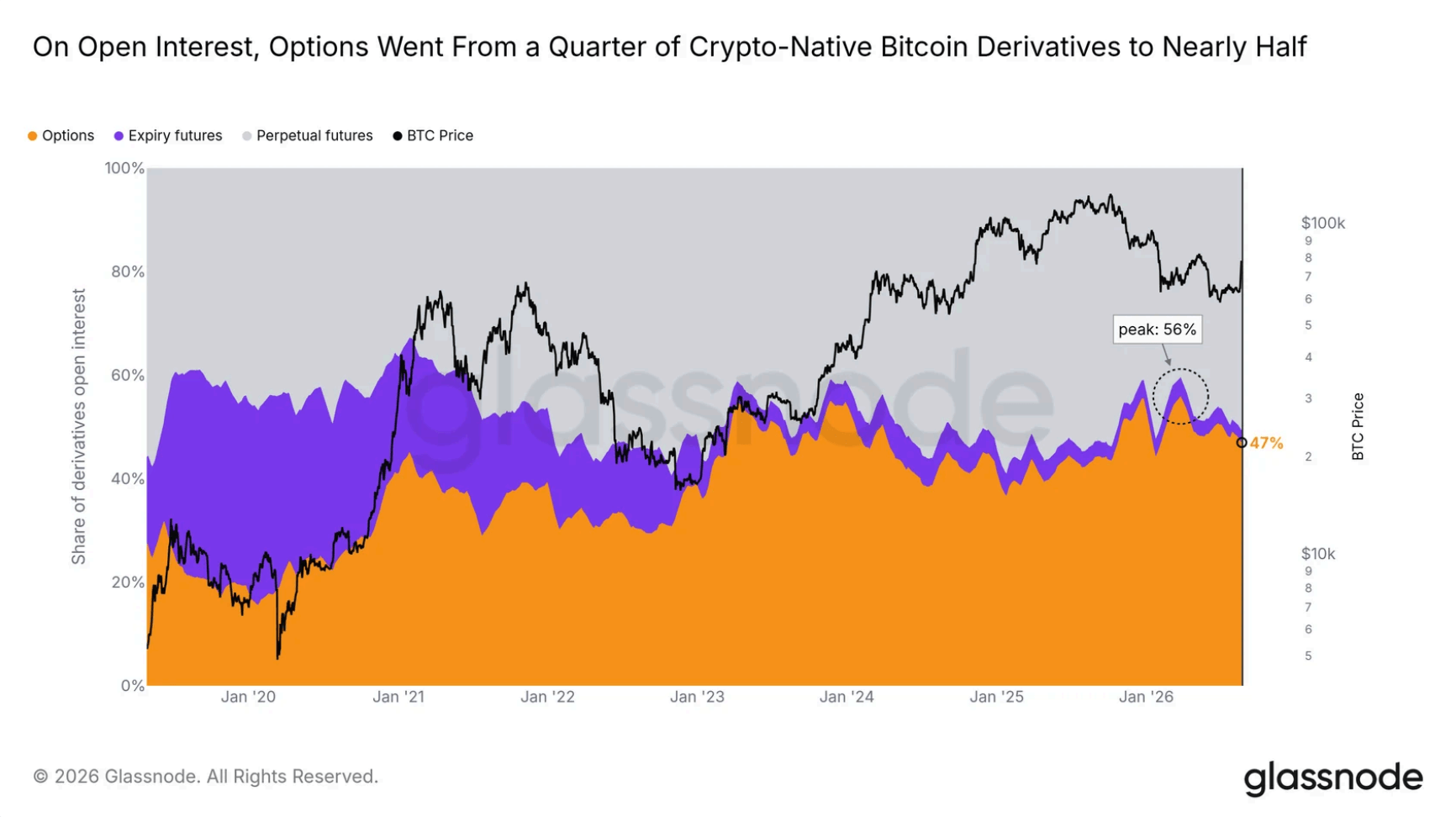
According to data tracked by Glassnode, regular futures trading on offshore exchanges is currently down about 97% from 2021 levels. At the same time, the share of outstanding contracts in options has risen from initially around one-quarter of crypto native bitcoin derivatives to nearly half, with four of five market phases since 2019 studied by Glassnode achieving share growth.
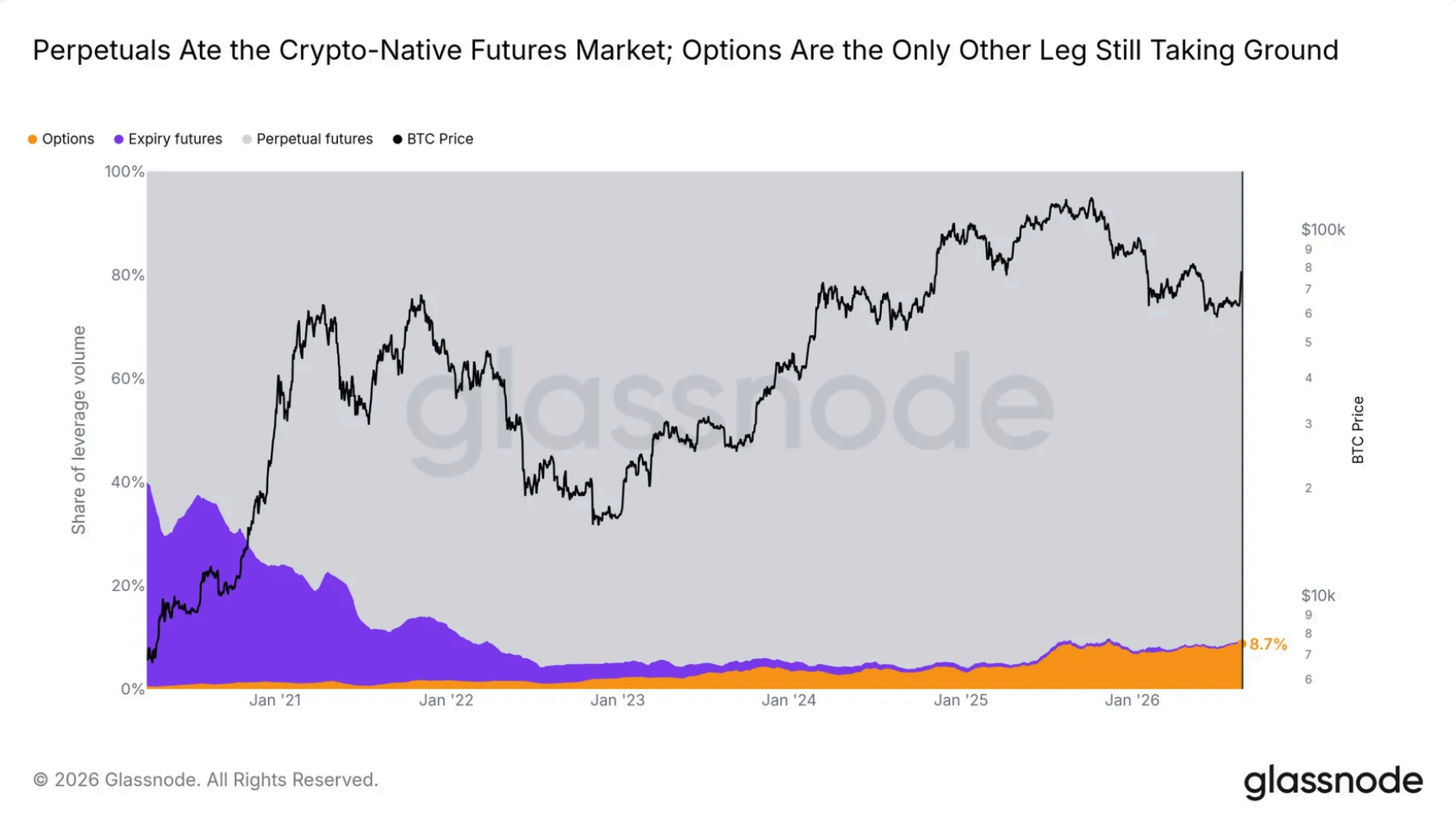
On the face of it, this appears to be an option replacing a futures contract, but in reality that is not the case. The Bitcoin derivatives market has divided the original futures market into two categories which are better suited for different risk needs: perpetual contracts become the most convenient leverage-oriented instruments with no need to worry about expiration dates, while options undertake hedging, volatility, downside protection and trading demands structured around specific prices or dates.
CryptoSlate has been following this trend for years. Its 2024 market report noted that large-scale options expirations are already restructuring outstanding contracts and affecting short-term trading. By March 2025, the ratio of Bitcoin options to futures outstanding contract increased from 57.8% to 69.6% in one week, while Ethereum's share was still much lower. In January 2026, the proportion reversed for the first time: BTC OTC Outstanding Contracts reached about $74.1 billion, exceeding Futures by around $65.22 billion, which is the first recorded option holding size over futures on Cryptoslate.
The new data from Glassnode further complements what these snapshots can't, showing a re-ordering across several market cycles and more importantly giving an insight into where the original futures trading activity was headed.
The futures market is divided into two.
Traditional futures have an expiration date. After purchasing a Bitcoin future delivered in December, the contract will eventually expire and traders must settle, close out or extend their positions to the next term.
This structure still works well in traditional markets built around standardized monthly and quarterly contracts. But the crypto market trades round-the-clock, eventually giving rise to products that are better suited for this environment.
There is no expiry date for perpetual contracts, and traders can hold positions indefinitely as long as there is enough collateral; the periodic payment of fees between both parties helps keep contract prices close to spot. This is almost unparalleled for a trader who only wants to gain Bitcoin leverage: without managing the contract's maturity or judging which term has the deepest and largest liquidity, perpetuals naturally become the preferred venue for trading.
A market snapshot of Binance on September 18 shows the extreme extent of this preference. At approximately 03:25 EST, BTCUSDT's perpetual holdings were about 108,289 bitcoin outstanding contracts and BTCUSDC's had another 19,465, accounting for an unbalanced position of $9.93 billion at their respective benchmark prices; whereas USD collaterals expired on September 25 and December 25, respectively, amounted to only around 77 million dollars, with two large stablecoins holding 129 times as much in uneven positions.
This is just a one-time data for a single exchange and should not be taken as an overall market share, but it clearly explains why the contraction of regular futures activity on crypto native platforms isn't mysterious: traders who want linear leverage already have alternatives with deeper liquidity and lower maintenance costs.
Glassnode's broader derivatives data points in the same direction: regular futures activity has declined sharply from 2021 levels, and perpetuities have absorbed much of the leverage that would otherwise remain on the futures market. Options are also expanding concurrently, but not exactly the same deals are being competed for.
This distinction is crucial, as otherwise the NPL data would make very different products appear interchangeable. The risks represented by a one-dollar perpetual contract are not identical to those of an NPL for a dollar option: perpetuals are essentially linear instruments and the returns from options depend on the strike price, expiration date, volatility and how Bitcoin's price relates to them.
This allows holders to protect large Bitcoin positions without having to sell them, or lock in downside risk while retaining some upside; traders who expect significant volatility but are unsure of the direction can directly trade volatility itself. Once there is enough market depth to support these trades, periodic futures lose all justification for hedging.
Why the value of options has risen so much
The simplest explanation for the growth of options is that Bitcoin's ownership structure has changed.
Early crypto cycles were dominated by participants who made direct bets, buying at the bull's-eye, shorting on the bearish side or leveraging in either direction.
The problem changes when there is a large number of holders on the market who do not intend to sell bitcoin. U.S. cash ETFs hold bitcoins for investors that may have held them for several years, companies include it in their balance sheets, and funds around which investment management, merchandising and structured products departments hold inventory to provide liquidity or package returns.
These holders don't always want more or less bitcoin, often just adjusting the risk of already held assets. This is where options are most attractive: funds that fear withdrawal can buy bearish rather than sell Bitcoin; holders willing to give up part of their trading space can reserve and sell a bearish option; those who expect large fluctuations but do not know which direction to trade may trade volatility instead of choosing an open-ended direction.
Options are also deeply embedded in the marketplace due to their hedging behaviour as traders. Traders who sell options will buy and sell bitcoin or futures with changes in option delta, which means that the book of options directly affects the liquidity of cash and perpetual contracts. Therefore, even if the buyer does not make a directional bet, options are increasing in importance.
Glassnode's data shows that this is not an exclusive phenomenon for bull markets: in four of the five market phases since 2019, options achieved share growth, with some of the fastest expansion occurring precisely during a long bear market. This is consistent with the characteristics of options, which do not require price increases to be valuable and whose importance instead rises when investors are more focused on risk formations.
The underlying collateral structure of the market is also changing. Early crypto derivatives often use bitcoin itself as a security, which creates a vicious cycle during sell-offs: while losing positions, the value of collaterals is falling and leverage trading becomes most vulnerable when volatility intensifies. Stability coins and cashback securities separate these two risks.
Options trading platforms are also much deeper than they were a few years ago. Glassnode's comparative study of the four platforms found that Bybit's share in tracked bitcoin option transactions rose from less than 10% to 28%, its options book expanded from $529 million during its first month online to $2.33 billion, with ethereum accounting for about one-third of its options trades over the past 90 days. These exchange-level data come from research done in collaboration with Bybit and should be read as part of this partnership.
Regular futures still have their place
The data on Glassnode needs to be aware of an important boundary: its options comparison only covers crypto native platforms, while the futures study targets offshore exchanges and explicitly excludes CME.
Therefore, the judgement that periodic futures are disappearing should not be extended to the entire Bitcoin market.
Customers and uses of CME futures services tend to vary. Regulated asset managers, hedge funds, banks or underlying traders may prefer a standardized CME contract because it is integrated into well-established collateral, clearing, compliance and risk control systems.
Cash ETFs further enhance the importance of institutional futures markets. Funds can hold cash pools and hedge short-term positions; underlying traders can buy Bitcoin or an ETF and sell futures when there is a price gap sufficient to cover financing and execution costs; market makers may also use CME positions to hedge outlets held elsewhere.
This can create large open positions, but does not necessarily indicate that these traders are short on bitcoin. Therefore the CFTC leverage fund's open data needs to be interpreted in conjunction with the underlying environment and overall trading structure.
In summary, fixed-term futures have not disappeared in all markets; rather the role has become more specialized: offshore crypto native exchanges are building better tools for sustained directional leverage with perpetuity contracts; there is still reason to use standardized futures through CME's by regulated entities; and options expand into a wide space between the two to meet investors' needs for managing volatility, downside risk, specific maturity risks, and unwillingness to sell portfolios.
Today's bitcoin derivatives market is very different from what it was five years ago: perpetual contracts carry most of the original leverage, options increasingly assume complex risk management around leverage and CME futures reserve a regulated channel for institutions that require standardised contracts and mature liquidation.
Rather than being replaced by a single product, the legacy function of recurring futures has been decentralized. Compared to the size of any single derivative market, this is more indicative that bitcoin trading itself has matured. A market dominated by single leverage contracts is built primarily around betting, while one with deep inventory holdings, perpetual liquidity and regulated futures and large options markets is built around long-term holding of bitcoins and determining what risks are worth retaining over time.
This article was originally published on CryptoSlate.
评论