
Gemini AI Forecasts Cardano's Native Token Price as the Network Adds Token Freezing Capabilities
Cardano Foundation launched CIP-0113 on October 7 after independent security audits, giving regulated token issuers tools to freeze balances, seize holdings, restrict transfers, and enforce identity checks on newly issued tokens. The standard went live on mainnet without requiring a hard fork. In the same session, ADA fell 4.86%, and its price was later reported at $0.2538, down over 8% in the last 24 hours, with volume sitting at 23.79 million.
The immediate market question was whether the price move reflected concern about the new compliance powers. The Foundation’s clarification addressed that directly: ADA itself cannot be frozen under CIP-0113, and the freeze-and-seize controls apply only to tokens issued under the standard.
What CIP-0113 Gives Token Issuers
CIP-0113 is designed for assets that need built-in compliance controls. Issuers using the standard can embed rules that run before a token transfer completes. These rules can include identity checks, sanctions screening, transfer restrictions, and issuer-defined freeze or seize actions.
The technical design keeps tokens inside shared smart contracts that check the applicable rules before any transfer is finalized. Issuers can choose from predefined rule sets or write their own rules, and those rules can be updated as regulations change. The launch did not require a hard fork, which reduces the disruption normally associated with adding new network-level functionality.
Cardano Foundation chief executive Frederik Gregaard framed the logic as making rules travel with the asset and be enforced each time the asset moves. That design is aimed at regulated stablecoins, tokenized bonds, and investment funds, where compliance controls are not optional features but a condition for operating in regulated markets.
Support is already appearing across parts of the Cardano ecosystem. Eternl, GeroWallet, CardanoScan, and BloxBean are listed as supporting the standard.
Why the Criticism Centers on Freeze and Seize Powers
The standard’s most sensitive feature is not that it exists for regulated tokens, but that it gives authorized parties new control paths. Tokens issued under CIP-0113 can let an authorized party move holdings without the owner’s agreement, which is where the freeze and seize powers intersect with censorship-resistance expectations.
The Foundation’s position is that this risk is contained by scope. The rules apply to newly issued tokens built under CIP-0113, not to ADA itself. For ADA holders, that distinction matters because the native token’s transferability is not changed by the standard.
Criticism has already been recorded in the public discussion. The source also noted that lending platforms are being told to examine those powers before accepting such tokens as collateral. That warning matters for DeFi and lending markets, where token collateral is often valued for its liquidity and its resistance to unilateral issuer action.
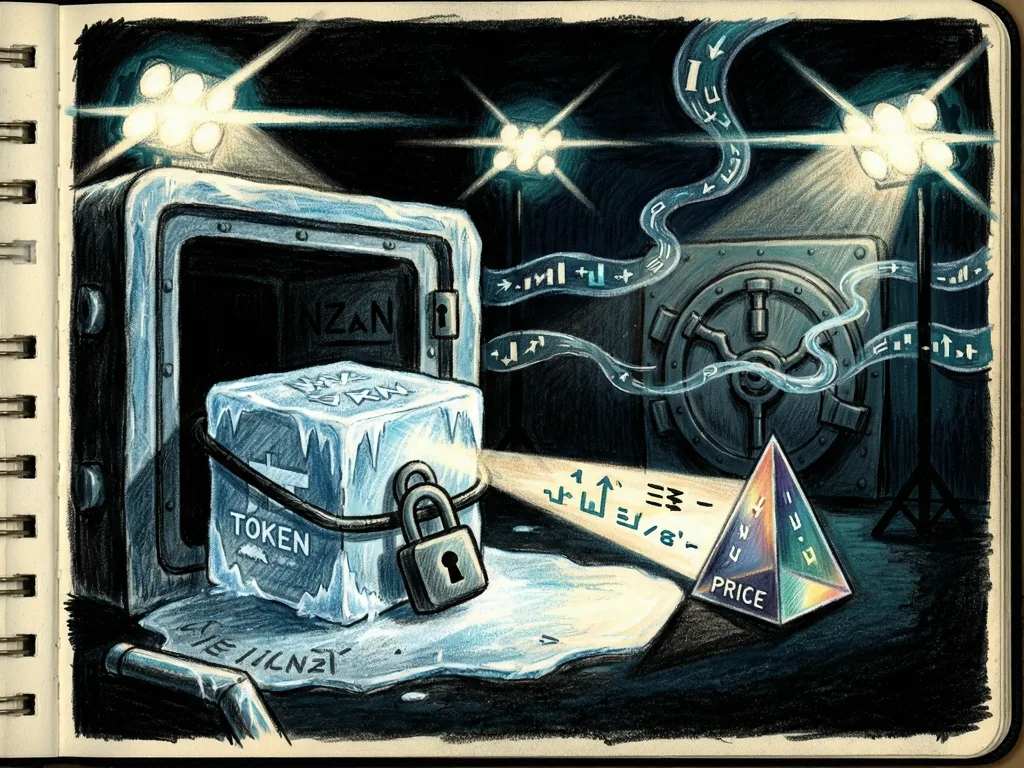
The broader tension is straightforward: institutions want assets that can be clawed back when compliance requires it, while traders and crypto purists want assets that no party can move without the holder’s consent. CIP-0113 chooses the first audience.
Short-Squeeze Narrative Challenged by Open Interest Data
Some coverage attributed ADA’s earlier rally to a short squeeze, pointing to falling open interest. Santiment’s closing data told a different story.
Santiment Intelligence posted on October 6 that ADA rose about 10% from October 3 to October 5 while open interest rose about 25% over the same two days, reaching $304 million. That combination does not fit a simple short-squeeze pattern, where rising price usually accompanies falling open interest as short positions are forced to close.
Monday added another data point. ADA gained 11%, and Santiment said whale transactions ran at roughly 2.2 times the weekday average while social volume sat at just 1.1 times baseline. In that sequence, large holders were active before retail attention fully arrived, and the price still rose.
Social Buzz Peaks While Price Falls
The current pattern is different. Santiment recorded 157 ADA whale transactions above $100,000, the highest count since June 4. At the same time, social dominance reached 1.16%, the highest reading of 2026.
That is the key mismatch. ADA captured more of the crypto conversation than it had all year, but the price did not respond in the same way. Instead, the market saw a 4.86% session drop and a 24-hour decline of more than 8%.
Santiment’s framing is that attention and demand are not the same thing. When whale activity led social interest and price rose, the move looked like informed positioning. When social dominance peaked while price fell, the move looked like retail attention arriving without matching buying pressure.
Gemini AI’s analysis in the source described near-term pressure on ADA, noting that the loudest retail interest of 2026 arrived on a red candle rather than a green one.
Gemini AI Levels in Focus
The source’s Gemini AI chart analysis centered on three levels.
The first is $0.2371. That level was reclaimed during Monday’s rally after having capped price through 2023. The current pullback is the first real test of whether $0.2371 has flipped from resistance into support.
The second is $0.2956. The analysis described it as the ceiling that rejected ADA in the spring and again in June, roughly 16% above the reported spot price.
The third is $0.4019. That is the 2023 range high and, according to the source’s Gemini AI output, the only level that would confirm a trend change.
The analysis also noted that the 200-day EMA near $0.2409 had already been breached. That matters because it means the price is testing a structural zone that previously capped movement, not simply pulling back from a recent high.
What Comes Next
CIP-0113 is a real infrastructure step for Cardano’s regulated token market. It gives issuers a way to embed compliance rules directly into assets without a hard fork, and it targets products where identity checks, sanctions screening, and transfer restrictions are commercially necessary.
For ADA holders, the direct effect is different. The standard does not freeze ADA and does not change ADA’s native properties. The price reaction instead reflects market psychology around freeze-and-seize language, social attention peaking into weakness, and the chart now turning toward the $0.2371 level that Monday’s rally reclaimed.
Risk Warning
This article is provided for information and news compilation purposes only. It does not constitute financial, legal, tax, or investment advice, and should not be used as a basis for any trading or capital allocation decision. Crypto assets, including ADA and tokens discussed, are highly volatile and may rapidly lose value or become illiquid. Technical analysis, AI-generated forecasts, on-chain data, and social sentiment can be incomplete, delayed, or misleading. Readers should independently verify facts, assess risks, understand regulatory and custody implications, and consult qualified professionals before making any investment decision. Always act with caution and rational judgment.
评论